Gurukshetra Stories and Incidents

M/s Gurukshetra Consultancy has focus on strategic communication (Advocacy), Promotors, senior Leadership and CXOs image & positioning, aligning Corporate Social Projects with corporate objectives and streamlining internal communication of corporate structure. M/s Gurukshetra Consultancy is all about defining unlimited contribution and scope of Gurus of Corporate World towards positioning industry, society at large and the country, their Kshetra. Gurukshetra would also feature success stories of CXOs and professionals - people who matter and are Gurus of their own Kshetra.
Showing posts with label Hindustan Zinc. Show all posts

VEDANTA KHUSHI - JEEVAN TARANG ENHANCING SPECIAL TALENT OF SPECIAL CHILDREN

Hindustan Zinc improving academic opportunities of these specially abled children by distributing Android Smartphones to educate & learn…

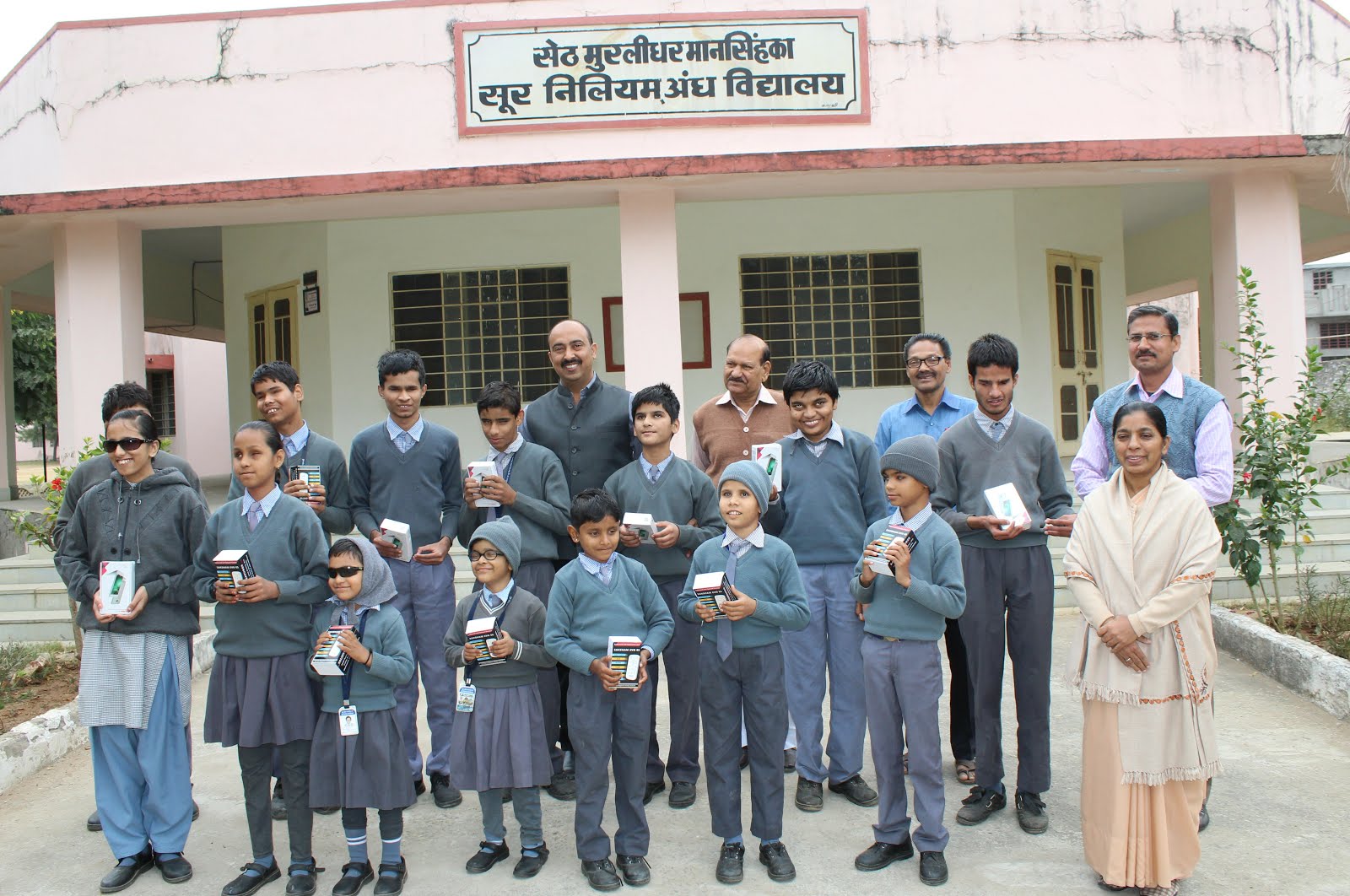
Hindustan Zinc under its unique initiative  - “Jeevan Tarang”, on the occasion of World Disability Day distributed Android Smart Phones to blind students of Pragya Chakshu School, Udaipur and Badhir Baal Kalyan Vikas Samiti, Bhilwara on 4th December, 2017 with an objective of enhancing academic opportunities for these children and mainstreaming them into the society.

These Android Smart phones will enable the visually impaired students to ‘Read & Write’ using Accessibility Features on the device. These phones will allow these students to access their textbooks in DAISY format from the world’s largest Online Library for the Print Disabled – ‘Bookshare’. This will bring these students at par with other students by allowing them to comprehend, read and prepare their academic content for better understanding hence making them competitive & ready for any exam. These Accessible devices will also allow the students to access the power of the internet and also gain worldly knowledge. They will also be able to enjoy games specially designed for Blind users on their phones.

The report says, India is home to the world's largest number of blind people. Out of 37 million people across the globe who are blind, over 15 million are from India. It is also known that quality education is an absolute necessity in order to succeed and progress in this knowledge driven world. Most of the current educational curriculum is oriented towards the use of the eyesight thus poses paramount challenges to the blind and visually impaired students.

Many organizations are working consciously and tirelessly to ensure these children get their due attention. Through Jeevan Tarang, Hindustan Zinc has provided these Android phones to the students from Class 1st – Class 5th of Pragya Chakshu School, Udaipur and to all the students of Badhir Baal Kalyan Vikas Samiti, Bhilwara accessing them the basic human right to educate & learn, a critical step on the path to economic, educational, and social development. Hindustan Zinc has partnered with experts to build capacities of these institutions and under this initiative Mr. Nitin Patel has been appointed in both these schools as a trainer to train these students in these advanced gadgets.

The Chief Guest of the event, Amitabh Gupta – CFO, HZL expressed his happiness to see the passion of these students to learn and climb up the ladder of success. He emphasized that through Jeevan Tarang, Hindustan Zinc strives to provide better opportunities to these students to grow and learn.

Pavan Kaushik – Head Corporate Communication said “There is a need to understand and up-bring these children with all love and care. Jeevan Tarang is an initiative to ensure that every single ability & disability gets the same opportunities and recognition thus ensuring the development of both social & cognitive skills.”

‘Jeevan Tarang’ endeavours to support people with disabilities, with a focus to identify needs of deaf-mute, visually impaired and children with brain damages. Around 500 beneficiaries have been identified from HZL’s operational areas; Kayad Mine, Rampura Agucha Mine, Chanderiya Smelting Complex and Udaipur. 

VEDANTA KHUSHI - MINT - STATES SHOULD SPEND MORE ON NUTRITION

Greater fiscal autonomy has not yet translated into higher spending on nutrition by states

Malancha Chakrabarty I September 11th, 2017
India’s record in addressing undernutrition is abysmal. With a stunting rate of 38.4%, India accounts for about a third of the world’s stunted children. Photo: AFP
Mohandas Karamchand Gandhi once said, “There are people in the world so hungry, that God cannot appear to them except in the form of bread.” Sadly, hunger and undernutrition continue to plague our country. India’s record in addressing undernutrition is abysmal. With a stunting rate of 38.4%, India accounts for about a third of the world’s stunted children. The proportion of wasted children in India increased from 19.8% in 2005-06 to 21% in 2015-16. Moreover, in states like Bihar and Madhya Pradesh, more than 40% of the children are underweight. Thus, nutrition should be high on India’s list of development priorities.
To be fair, India has a number of nutrition intervention programmes under different ministries. In absolute terms, India’s expenditure on nutrition schemes is quite high at Rs2.98 trillion but this is woefully inadequate if we take into account the level of deprivation in India.
Moreover, dramatic changes in the fiscal architecture based on the recommendations of the Fourteenth Finance Commission have raised serious concerns with regard to public spending on nutrition.
There has been a substantial decline in allocation for Central schemes. The Integrated Child Development Services Scheme (ICDS), a key scheme which provides basic education and health services to women and children below six years, suffered serious budget cuts. Allocation for ICDS declined consistently from Rs16,684 crore in 2014-15 to Rs15,489 crore in 2015-16 and Rs14,736 crore in 2016-17. Although 2017-18 saw an increase in the allocation for ICDS to Rs16,745.2 crore, this figure is only 0.5% higher than the actual expenditure incurred in 2014-15.
In the case of other schemes, like the Rajiv Gandhi Scheme for Empowerment of Adolescent Girls, also known as Sabla, and the Mid-Day Meal Scheme (MDMS), budget cuts were deeper. The outlay for Sabla declined from Rs622.4 crore in 2014-15 to Rs475.2 crore in 2015-16, and to Rs460 crore in 2016-17. In 2017-18, the allocation has been kept at the same level as 2016-17, which actually implies a decrease in allocation in real terms.
In the case of MDMS, there was a persistent decline in allocation from Rs10,917.6 crore in 2013-14 to Rs10,523.4 crore in 2014-15, and further down to Rs9,144.9 crore in 2015-16. In 2017-18, there was only a 3% increase in allocation, from Rs9,700 crore in 2016-17 to Rs10,000 crore. Again, the allocation in 2017-18 is lower than the actual expenditure of Rs10,761.4 crore incurred under the scheme in 2012-13. Even the 3% increase over last year does not mean much if inflation is factored in.
However, some Central schemes did witness an increase in allocation. The Maternity Benefit Programme, a conditional cash transfer to pregnant and lactating women to provide compensation for wage loss and adequate nutrition and rest, witnessed an increase in allocation from Rs634 crore in 2016-17 to Rs2,700 crore in 2017-18. The total cost of the programme up to 2019-20 is Rs12,661 crore for 5.17 million beneficiaries. However, nutrition experts regard this as inadequate because the number of beneficiaries under other schemes, notably the Janani Suraksha Yojana, was much higher at about 7.5 million, and that too in 2015-16.
Although the whole argument behind fiscal restructuring was that with more resources at their disposal, states would step up their expenditure, data on state budget allocation for nutrition schemes is not encouraging.
In fact, 2015-16 witnessed a decline in budget allocation in many states. In Uttar Pradesh, the total budget outlays for nutrition-specific interventions declined from Rs4,358.1 crore in 2014-15 to Rs4,054.9 crore in 2015-16, and subsequently increased to Rs4,573.3 crore in 2016-17. Budget outlays for micronutrient supplementation and deworming declined from Rs67.7 crore in 2014-15 to Rs58.9 crore in 2015-16, and Rs56.5 crore in 2016-17.
Similarly, in Odisha, the budget for nutrition-specific interventions declined from Rs1,188 crore in 2014-15 to Rs961 crore in 2015-16, and then increased to Rs1,302 crore in 2016-17.
In Bihar, there was a small increase in the allocation for nutrition-specific interventions, from Rs1,778 crore in 2014-15 to Rs1,972 crore in 2016-17. Rajasthan witnessed a modest increase in outlay for nutrition-specific schemes from Rs975 crore in 2014-15 to Rs1,022 crore in 2015-16 and Rs 1,106 crore in 2016-17. But budget allocation for nutrition-specific schemes in 2016-17 is 13% lower than the budget allocation in 2014-15.
Thus, greater fiscal autonomy has not yet translated into higher spending on nutrition by states.
Two critical questions emerge. First, can the Centre renege on its responsibility at a time when a large proportion of India’s children are undernourished?
Second, given that states have a greater responsibility, what can be done to ensure that they step up their allocation for nutrition?
While the former is an ideological question, here are some recommendations for the latter. Firstly, the Centre and state should work together to set nutrition targets for every state and district. Secondly, the Centre should play a more proactive role in monitoring the nutrition programmes of every state. Lastly, effective steps need to be undertaken to upgrade capacity at the state level.

Read On: http://www.livemint.com/Opinion/m4LD40v1SB6S4OOSs0FCoL/States-should-spend-more-on-nutrition.html  
Malancha Chakrabarty is associate fellow at the Observer Research Foundation.

HINDUSTAN ZINC’S JEEVAN TARANG INITIATES ‘GARV SE’ CAMPAIGN FOR SPECIAL CHILDREN


Mainstreaming the specially abled children by bringing them together with the society/community…

Hindustan Zinc under its ‘Jeevan Tarang – Zinc Ke Sang’ Project has initiated around six month long Campaign – ‘Garv Se’ where these Special Children of God would be participating in series of creative activities to engage them with Hindustan Zinc employees & their families on a same platform.
The program has been formally launched by Hindustan Zinc Ladies Club on 26th September, 2017 where Painting Workshop along with other artistic activities – clay modelling, diya painting & block painting were organized that saw the participation of around 60 children from Viklang Kalyan Samiti, Udaipur & Prayas Sansthan, Udaipur.

The objective of the Campaign is to mainstream the specially abled children by bringing them together with the society/community and Garv Se has been a step towards it by engaging Hindustan Zinc employees and their families through the series of engagements – movie screening, sports, trekking, dance workshops to name a few.

"Jeevan Tarang - Zinc Ke Sang” was formally launched on Foundation Day of Hindustan Zinc, i.e., on 10th January, 2017.

The fact says that there are over 70 million disabled people in India out of which over 12 million are hearing impaired with hardly 500 government aided Deaf schools providing formal education to these children. Even the teachers working in these schools are not equipped or trained to teach the hearing impaired students as Sign Language is still not accepted as a medium of teaching and communication. More than 90 % of students with deafness do not have access to and are out of the formal education system. Lack of access to language has also kept the deaf away from development of social and cognitive skills.

Mr. Pavan Kaushik – Head Corporate Communication said “There is a need to understand and up-bring these children with all love and care. Jeevan Tarang is an initiative to work towards a more inclusive society, where every single ability & disability gets the same opportunities and recognition.”

‘Jeevan Tarang’ endeavours to support people with disabilities, with a focus to identify needs of deaf-mute, visually impaired and children with brain damages. Around 500 beneficiaries have been identified from HZL’s operational areas; Kayad Mine, Rampura Agucha Mine, Chanderiya Smelting Complex and Udaipur. Access to knowledge is a basic and human right, a critical first step on the path to economic, educational, and social development. Hindustan Zinc has partnered with experts to build capacities of these institutions.

Hindustan Zinc has also partnered with National Handicapped Finance & Development Corporation to support for Skill Building of the disabled persons from among Hindustan Zinc’s districts. 


Also present were Ms. Neelima Khetan – Head CSR, HZL, members of Hindustan Zinc Ladies Club along with HZl employees and their families during the program.

VEDANTA KHUSHI - JEEVAN TARANG - SPECIAL CHILDREN TO GET SPECIAL ATTENTION BY HINDUSTAN ZINC

Jeevan Tarang – Zinc ke Sang - to enhance education and skill opportunities of more than 500 children with disabilities…

There are few children that god has made with lots of love, affection & care and this is the reason, these children are known as 'special children of God'. These children make you smile instantly and also brings tears in our eyes. As these are special children,  they do require and need a lot of care and attention.  
Many organizations are working consciously and tirelessly to ensure these children get their due attention. “Jeevan Tarang” is a unique initiative launched by Hindustan Zinc, a Vedanta Group company with an objective of enhancing education and skill opportunities for the disabled, and mainstreaming them into the society. Under the program, around 500 beneficiaries have been identified from Hindustan Zinc’s operational areas by working with schools for deaf-mute, visually impaired and for children with brain damages in Ajmer, Bhilwara, Chittorgarh and Udaipur.
"Jeevan Tarang - Zinc Ke Sang” was formally launched on Foundation Day of Hindustan Zinc, i.e., on 10th January, 2017.
On 30th August, 2017, on Zinc Day, Children of Jeevan Tarang from Shri Sanwaliya Bahuuddeshay Viklang Seva Sansthan (SSBVSS), Chittorgarh, Baadhit Baal Vikas Samiti, Ajmer, Viklang Kalyan Samiti, Udaipur and Badhir Baal Vikas Kalyan Samiti, Bhilwara performed during the cultural evening and enthralled the audience with their beautiful heart touching performances.
During the program, Hindustan Zinc also partnered with Noida Deaf Society(NDS) to develop a long-term vision and roadmap for the institutes of Deaf-Mute children. NDS has set up four permanent separate trainers (Deaf Mute themselves) who will teach Indian Sign Language(ISL) to students. Jeevan Tarang  also focuses on capacity building of teachers by teaching them ISL, who then will be equipped to teach the courses in ISL. Through this partnership, the aim is to enable 400 children learn sign language so to empower the children by imparting education and vocational training for rehabilitation of hearing and speaking impaired children, instilling self-confidence and skills & qualitatively improve both their professional and personal potential to be an active contributor to society.
During the program, Mr. Sunil Duggal – CEO, HZL said “The need is to up-bring these children with all love and care. After all they are special children of god and through Jeevan Tarang we strive to provide them with better opportunities to grow and learn.”
The fact says that there are over 70 million disabled people in India out of which over 12 million are hearing impaired with hardly 500 govt aided Deaf schools providing formal education to deaf children. Even the teachers working in these schools are not equipped or trained to teach the hearing impaired students as Sign Language is still not accepted as a medium of teaching and communication. More than 90 % of students with deafness do not have access to and are out of the formal education system. Lack of access to language has also kept the deaf away from development of social and cognitive skills.
Mr. Pavan Kaushik – Head, Corporate Communication said “Jeevan Tarang is an initiative to work towards a more inclusive society, where every single ability & disability gets the same opportunities and recognition. Hindustan Zinc has partnered with experts to build capacities of these institutions and also engaging industry representatives to ensure good job opportunities for them.”

Also present were Mr. Ashwin Bajaj – Director, Investor Relations, Vedanta Group, Mr. Amitabh Gupta – CFO, HZL, Mr. Naveen Singhal – Head Projects, HZL, Mr. L.S. Shekawat – COO, Mines, Mr. Pankaj Kumar – COO, Smelters, Mr. Ramakrishnan Kasinath – Chief Commercial Officer, HZL, Mrs. Sonal Shrivastava – Dy. CFO, Mrs. Neelima Khetan – Head CSR, HZL, Mr. V. Jayaraman – Head EOHS, Ms. Ruma Roka – Founder of NDS and other HZL representatives during the program.

SMT. ANITA BADHEL INAUGURATES 2 NAND GHARS IN UDAIPUR, DEDICATES 318 ANGANWADI CENTRES IN KHUSHI

So far, more than 100 “Nand Ghars” have been constructed across three states and 2911 Anganwadi Centres have joined “Khushi” Project…

On 4th August, 2017, 2 more “Nand Ghars” - Dhawaditalai and Main Rawa were inaugurated in Rawa village of Girwa Block at Udaipur District by Chief Guest – Smt. Anita Bhadel – Hon’ble Minister of Women and Child Development, Government of Rajasthan and now 20 Nand Ghars have been constructed in Udaipur district with 100 more Nand Ghars in pipeline.

During the inaugural ceremony, Smt. Bhadel said “For the progress of the country, along with infrastructure development, it is important to focus on  human development. Anganwadis strengthens the foundation of children below the age of seven years - their nutrition, health and education. Government and Vedanta Hindustan Zinc have come forward with well-equipped facilities for both mother and child including skill training for women in the form of ‘Nand Ghar’. Now communities have to take the responsibility of Nand Ghars to make it successful”.

To make the project more cohesive, “Nand Ghar” act as a focal area for immunisation, gender sensitisation and maternal care. It also aims to enhance the learning environment through an e-learning module and skill enhancement program for women where they will undergo entrepreneurship training, including skill enhancement, to start their own micro enterprise with credit linkages, thereby increasing their contribution towards the Indian economy.

During her visit to Udaipur, Smt. Bhadel also launched “Khushi” project in Chawand village wherein 318 Anganwadi Centres of Sarada Block have been included under the project as part of Phase-2.

During the launch program, Smt. Bhadel said “Through Khushi project, Anganwadi program will be strengthened to improve attendance, health and the well-being of Anganwadi children. Now communities have to come forward and support it by actively participating in it".

In year 2015, Hindustan Zinc signed the MoU with Government of Rajasthan to strengthen 3055 Anganwadis of the ICDS Department in 5 districts i.e. Udaipur, Rajsamand, Chittorgarh, Bhilwara and Ajmer of Rajasthan under its flagship project “Khushi” in 2 phases.


Last year under “Khushi” project, Hindustan Zinc reached out to 2295 Anganwadi centres in 5 districts of Rajasthan in phase 1. So far in Udaipur district, Hindustan Zinc with partner NGO – Seva Mandir has included 1157 Anganwadi Centres under “Khushi” Project.

VEDANTA HINDUSTAN ZINC OPENS 2 NAND GHARS IN AJMER, RAJASTHAN

Delivering long-term benefits to communities by strengthening the foundation of children below the age of seven years - their nutrition, health and education… 

The report says, there are 7.5 crore underprivileged children living in remote rural areas, below the age of seven years, who are in need of proper nutrition, health care and education. Our primary focus, therefore, is to start at the grass root level with the holistic development of children and women, who form the future of our nation.

This is where, Vedanta came up with the concept of “Nand Ghar" designed in partnership with the ministry of women and child development. It is an extension to the existing Anganwadi initiative for providing a better environment to the children of India by addressing issues relating to pre-primary education, health care, nutrition and economic empowerment for women in rural India.

Mr. Anil Agarwal – Chairman, Vedanta Group believes “In order to secure the future of India, we have to safeguard the present. To strengthen the foundation of children, it is important to address issues relating to pre-primary education, health care, nutrition for children and economic empowerment for women in rural India”.

Taking his vision forward, Vedanta has joined hands with the Government to revamp 4000 anganwadi centres across India under the Project ‘Nand Ghar’. Today, more than 100 “Nand Ghars” across three states has resulted in marked improvement in attendance, learning abilities and school readiness, by deploying e-learning modules in education and soft skills in collaboration with world-class partners and they are now equipped with TVs, solar panels and toilets. 

On 31st July, 2017, 2 “Nand Ghars” - Khanpura & Parbatpura have also been inaugurated in Ajmer District by the Chief Guest - Ms. Anita Bhadel – Hon’ble Minister of Women and Child Development, Government of Rajasthan and with this 10 Nand Ghars have been constructed in Ajmer district with 25 more Nand Ghars are in pipeline.

During the inaugural ceremony, Ms. Bhadel said “Government and Vedanta Hindustan Zinc have done their bit by providing well equipped facilities for primary education, nutrition services along with related healthcare services for both mother and child including skill training for women, it’s now the communities have to come forward and support it by actively participating in it.” She also mentioned that if a mother anchors the responsibility of her child’s education, the benefit will percolate to her next 7 generations.

To make the project more cohesive, “Nand Ghar” act as a focal area for immunisation, gender sensitisation and maternal care. It also aims to enhance the learning environment through an e-learning module and skill enhancement program for women where they will undergo entrepreneurship training, including skill enhancement, to start their own micro enterprise with credit linkages, thereby increasing their contribution towards the Indian economy.

The Nand Ghars are in line with Prime Minister of India’s vision of social development and will prove to be a stepping stone for building the future human capital as productive, passionate and persistent towards the growth.


Also present on the occasion were Mrs. Neelima Khetan – Head CSR, HZL, Mr. Sampat Sankhla – Dy. Mayor, Ajmer,  Mrs. Anupama Tailor – Dy. Director, Women & Child Development, Mr. Nitesh Yadav - ICDS, Mr. Raes Ahemad - Counsellor along with Anganwadi workers and Hindustan Zinc’s CSR representatives.


VEDANTA KHUSHI - 264 ANGANWADI CENTRES JOIN “KHUSHI” IN KOTRA

Hindustan Zinc reaching out to 3055 Anganwadis of the ICDS Department in 5 districts of Rajasthan i.e. Udaipur, Rajsamand, Chittorgarh, Bhilwara and Ajmer…

“Care for the underprivileged children is very close to my heart” says Anil Agarwal, Chairman of Vedanta Group. “No child in India should remain malnourished and be deprived of nutrition, health and primary education” is what his vision is. In this process Vedanta initiated adoption of government run Anganwadis in the year 2008. The intervention was for a limited period, benefiting children in age-group of 0-6 years.

In year 2015, Hindustan Zinc signed the MoU with Government of Rajasthan to strengthen 3055 Anganwadis of the ICDS Department in 5 districts i.e. Udaipur, Rajsamand, Chittorgarh, Bhilwara and Ajmer of Rajasthan under its flagship project “Khushi” in 2 phases.

Last year under “Khushi” project, Hindustan Zinc reached out to 2295 Anganwadi centres in 5 districts of Rajasthan in phase 1.


As part of Phase 2, on 29th June, 2017, Hindustan Zinc with partner NGO – Seva Mandir has now included 264 Anganwadi centres in Kotra Tehsil of Udaipur district and this year, the company will be covering more than 760 Anganwadi centres in Udaipur district of Rajasthan. The Chief Guest of the event was Ms. Taru Surana – Dy. Director, ICDS, Udaipur District who unveiled “Khushi” Board to initiate the program. During the program, Ms. Taru said “Anganwadi program will be strengthened with the intervention of Hindustan Zinc to improve attendance, health and the well-being of Anganwadi children.”

VEDANTA KHUSHI - INDIAN EXPRESS - ANGANWADIS: A REPORT CARD

By Shradha Chettri | New Delhi | Updated: June 19, 2017 
The Indian Express visited 14 Anganwadis, and found similar problems almost everywhere...
A healthy meal and a stepping stone for school — anganwadis in the city have two key responsibilities. The Indian Express explores the problems at each front.
Five-year-old Naseem does not go to school, but that doesn’t mean he can stay at home after breakfast. As soon as the clock strikes 9 am, Naseem leaves home, unenthusiastically dragging his feet across a small drain filled with plastic. He eventually reaches a small room on the ground floor of A block, New Seemapuri, in northeast Delhi.
Six others, some younger than Naseem, are already there, with an old fan and a rug to keep them comfortable. A few tattered charts with alphabets and numbers hang on the wall.
Naseem is greeted by his teacher (officially a ‘worker’), a woman in her 30s. She marks him ‘present’, and he sits down to play with the plastic toys scattered on the floor.
He spends the next four-and-a-half hours at the anganwadi centre (AWC), which is supposed to provide him supplementary nutrition and prepare him for Class I. But his mother, Shabana, has a grouse: “He has been going to the anganwadi for over two years. Forget learning the alphabets, he still doesn’t know how to hold a pencil, or colour.”
The Indian Express visited 14 anganwadis, and found similar problems almost everywhere.
Shabana still sends her son to the AWC because that is the only time she gets to do tailoring work. Her husband is a daily wager. The couple have three other children — two study in a nearby municipal school and one in a Delhi government school.
As Naseem plays, another woman walks in holding two children, aged three and four, by their hands. She makes them sit alongside Naseem. She is a ‘helper’ at the AWC, responsible for bringing children aged six and below from the neighbourhood to the centre — under the Integrated Child Development Services (ICDS) Scheme.
Hard to swallow
The ICDS — under the Ministry of Women and Child Development, and looked after by the WCD department in each state — has been in place since 1975. It was restructured under the 12th Five-Year Plan to ensure holistic development of children aged six and below.
The aim was to reduce anaemia and child mortality rate by giving supplementary nutrition — especially to malnourished children — and to improve early learning outcomes.
Naseem’s teacher is meant to keep children engrossed till 12.30 pm, when food arrives. She makes them narrate a poem, but eventually they get fidgety and say they want to go home. The two women assure them they will get food soon. Eventually, men carrying two steel containers walk in around 11 am.
The food is to be distributed to children up to six years and pregnant and nursing mothers in the neighbourhood.
Today, the meal comprises pulao and salted chana (black gram). While there’s a different meal every day (see box), the snack alternates between black chana and white matar. The children — there are 6,97,158 in anganwadis across the city — know each day’s menu by heart. Even before the helper lifts the lid, Naseem says,“Aaj toh pulao milega. Mujhe toh sirf meetha dalia acha lagta hai, jo kal milega.”
The children line up with bowls. Some sit and eat, while Naseem runs home with the food. He keeps it in the kitchen and asks his mother for lunch. “Many children don’t like the food at the anganwadi. Naseem usually comes home and eats lunch,” says Shabana.
Sarita Dhariwal, a worker at an AWC a few blocks from Naseem’s home, explains why: “It is impossible to eat this rice. The chana has no salt. But children still eat the food because there is no one to cook for them.” Dhariwal, who has been at the centre since 2012, says the quality of food has deteriorated with each passing year. “It is only when there is news of an inspection that the quality improves,” she says.
Insufficient staffers
The food at the AWCs is supplied by non-profit organisations (NPOs) empanelled by the WCD department. There are 22 in the city and work is allotted through a tendering process. Each kitchen prepares food for 30-40 anganwadis.
The meal is supposed to provide 500 calories and 12-15 grams protein to children aged between 6-72 months, and 600 calories and 18-20 grams protein to pregnant and nursing mothers.
Dhariwal says she has raised the matter with her supervisor and the Child Development and Project Officer (CDPO). Since there are only 37 CDPOs for 95 projects, an officer cannot visit each centre under her daily, which means quality tends to slip. “Apart from visiting the centre, we also have a lot of administrative work. It is not possible to keep a record of every centre,” says a supervisor in south Delhi, who did not wish to be named.
There should be one CDPO for each project, but most positions haven’t been filled for years.
Deputy Chief Minister Manish Sisodia, who recently took additional charge of the WCD department, acknowledges the problem. “As services are no longer under the jurisdiction of the Delhi government, it has become difficult to appoint officers,” he says. For now, the minister has asked DANICS and ad hoc IAS officers to visit two anganwadi centres on Saturdays.
With few takers, most of the food at anganwadis in Sangam Vihar — one of Asia’s largest unauthorised colonies — is often thrown away. There are frequent complaints that the anganwadis have been serving the same snack every day. “Children get tired of eating the same thing. Since we have to keep them here till 12.30 pm, I buy biscuits for them,” says Suman Lata, a worker at AWC No. 100 in Hamdard Nagar.
Just like at her anganwadi, most other centres only have 10-15 children registered. Lata acknowledges that the number of children in the neighbourhood is far higher.
Former chairperson of the child welfare committee, Raj Mangal Prasad, says, “The government had decided that commercial ventures will not supply (food) and that work will be given to NPOs. But, ultimately, these commercial ventures started NPOs. The profit in food distribution is huge. Then there are supervisors who work with these NPOs, so monitoring quality has been a huge challenge.”
Each AWC gets food based on the number of children and women registered. NPOs are paid Rs 6 per day to supply meals for children below six years, Rs 9 per day for malnourished children, and Rs 7 per day for pregnant and nursing mothers.
A learning issue
Like Shabana, many other parents The Indian Express spoke to shared concerns about their children not learning enough.
Anganwadis are ideally supposed to serve as Early Childhood Care and Education (ECCE) centres, with Sisodia bringing in a fixed curriculum to be taught to children. By the time children leave the anganwadi, they should know the names of colours, seasons and learn how to write letters and numbers.
Four-year-old Rehan at anganwadi No. 104 in New Seemapuri plays with an alphabet cube, but doesn’t know what it is. “Mujhe nahi pata ye sab kya hai,” he says. The helper brushes it off, saying Rehan is not regular.
But Rajiv Kumar of local NGO Pardarshita says the problem with most anganwadis is a dearth of workers responsible for teaching.
“Helpers are supposed to collect children and serve food, while workers do the teaching. But many positions are lying vacant,” he says.
At Rehan’s AWC, too, the worker has been on leave for a while now. That many anganwadi employees haven’t been paid for as long as four months doesn’t help. A worker gets Rs 5,000 a month, while a helper makes Rs 2,500.
“When we ask supervisors, they say we will be paid soon. If they expect us to work properly, they should also pay us,” says a worker at a centre in Lal Kuan.
Those who are regular complain that they haven’t been trained enough. “The government sends new guidelines and course sheets, but we don’t get training. We have to know how to teach children. Some workers have not been trained in the last 10 years,” says Kavita Chauhan, an anganwadi worker at Lal Kuan.
Chauhan, who studied till Class X, was hired as a worker in 2012. She was trained for a week when she joined — and that was about it. During training, they were taught how to fill registers, weigh children and maintain a record of malnourished kids.
How well that data is maintained is another story. Sunita, a resident of E-block in Sunder Nagri, says that when her daughter was three years old, she weighed just 3.7 kg — much below the WHO standard of 10.7 kg.
Sunita, whose daughter is now six, says she used to visit the AWC near her home to weigh her child and get vaccinations. But no one told her the child was malnourished. When NGO Pardarshita conducted a survey between 2013 and 2014, they found the child needed immediate medical attention and took her to the hospital. Till date, she has not fully recovered.
Of the 580 children weighed in just one block in Sunder Nagri, 65 were severely malnourished and 131 were malnourished. This is in stark contrast to a monthly report of the WCD department across the city during the same
period, which showed only 201 children aged six or below were malnourished. “Anganwadis don’t have proper weighing machines… Many provide inaccurate measurements,” says Kumar.
Dhariwal says there is just one weighing machine for around 10 AWCs in the area. “We get to keep the machine for three days every month to weigh children at the centre and in the neighbourhood,” she says.
As per the National Family Health Survey (2015-2016), 27% of children in the city aged five or below were underweight, up from 26.1% in 2005-06. Similarly, 62.6% were anaemic, up from 57% in 2005-06. Field workers say the only way forward is to set up a state food commission, as mandated by the Food Security Act 2013.
“Section 6 of the Act is about malnutrition. The ICDS not recording this properly is a violation of the Act. The only solution is to establish a state food commission as a monitoring committee for such schemes,” says Arvind Singh of NGO Matri Sudha, which works in the field of nutrition and education.

VEDANTA KHUSHI - HINDUSTAN ZINC CELEBRATES WORLD ENVIRONMENT DAY


Employees and their Families participated and Nandghar children became guardian of the planet Earth... 

Hindustan Zinc celebrated “World Environment Day” on 4th & 5th June, 2017 at Head Office and at all its business locations. Hindustan Zinc believes World Environment Day is the opportunity for everyone to realize the responsibility to care of the Earth and to become agents of change.

During the occasion, Plantation drive was carried out at Zinc Park on 4th June, 2017 where Mr. Sunil Duggal – CEO, HZL, the Chief Guest of the program said ‘I feel more confident than ever that the power to save the planet rests with the individual consumer. Reserve and preserve it for the future of your children.

Various activities like exhibition, painting competition, inauguration of vermi compost set-up were planned to involve employees, their families and children. Painting competition was organized for children of employees on‘Connecting People to Nature’, the theme for World Environment Day 2017, to encourage people to get outdoors and into nature, to appreciate the beauty of planet, and to take forward the call to protect the Earth for prosperity.

Mr. V Jayaraman – Head EOHS, Mr. Ramakrishnan Kasinath – Head Commercial, Ms. Sonal Shrivastava – Dy. CFO, Ms. Neelima Khetan – Head CSR, Mr. Akhilesh Shukla  - Unit Head R&D - CRDL and other HZL employees along with their families also participated to make the planet greener’.

On 5th June, 2017, Mr. Sunil Duggal, CEO celebrated World Environment Day with children of Padakhadri Nandghar in Udaipur along with his wife Mrs. Ramdeep Duggal.

Mr. Duggal planted a Guava Tree at Nandghar with little Runika and  Mrs. Duggal planted a Mango tree with naughty Jitu. Hindustan Zinc also pledged to plant one fruit tree at every Nandghar. Apart from fruit trees, a seasonal vegetable garden was also set up at the Padakhadri Nandghar.

On this occasion, Mr. Duggal said – ‘let the children become the guardians of this planet, and let Nandghar teach them about caring and nurturing the environment’. During their visit to Nandghar, he interacted with children, participated enthusiastically in their poem recitation and other activites.

Mrs. Duggal also interacted with the parents of Nandghar children to understand the growth and change they see in their children.

Mr. Pavan Kaushik – Head Corporate Communication said “Hindustan Zinc has implemented extensive green belt development projects and has around 1.4 million of green cover around its operations.”

Also present were Mr. Manoj Nashine - Unit Head, Zinc Smelter Debari, Ms. Neelima Khetan - Head CSR, Ms. Priyanka Singh - CEO Seva Mandir and other representatives of HZL & Seva Mandir.