Gurukshetra Stories and Incidents

M/s Gurukshetra Consultancy has focus on strategic communication (Advocacy), Promotors, senior Leadership and CXOs image & positioning, aligning Corporate Social Projects with corporate objectives and streamlining internal communication of corporate structure. M/s Gurukshetra Consultancy is all about defining unlimited contribution and scope of Gurus of Corporate World towards positioning industry, society at large and the country, their Kshetra. Gurukshetra would also feature success stories of CXOs and professionals - people who matter and are Gurus of their own Kshetra.
Showing posts with label Vedanta Child Care. Show all posts

VEDANTA KHUSHI - JEEVAN TARANG ENHANCING SPECIAL TALENT OF SPECIAL CHILDREN

Hindustan Zinc improving academic opportunities of these specially abled children by distributing Android Smartphones to educate & learn…

Hindustan Zinc under its unique initiative  - “Jeevan Tarang”, on the occasion of World Disability Day distributed Android Smart Phones to blind students of Pragya Chakshu School, Udaipur and Badhir Baal Kalyan Vikas Samiti, Bhilwara on 4th December, 2017 with an objective of enhancing academic opportunities for these children and mainstreaming them into the society.

These Android Smart phones will enable the visually impaired students to ‘Read & Write’ using Accessibility Features on the device. These phones will allow these students to access their textbooks in DAISY format from the world’s largest Online Library for the Print Disabled – ‘Bookshare’. This will bring these students at par with other students by allowing them to comprehend, read and prepare their academic content for better understanding hence making them competitive & ready for any exam. These Accessible devices will also allow the students to access the power of the internet and also gain worldly knowledge. They will also be able to enjoy games specially designed for Blind users on their phones.

The report says, India is home to the world's largest number of blind people. Out of 37 million people across the globe who are blind, over 15 million are from India. It is also known that quality education is an absolute necessity in order to succeed and progress in this knowledge driven world. Most of the current educational curriculum is oriented towards the use of the eyesight thus poses paramount challenges to the blind and visually impaired students.
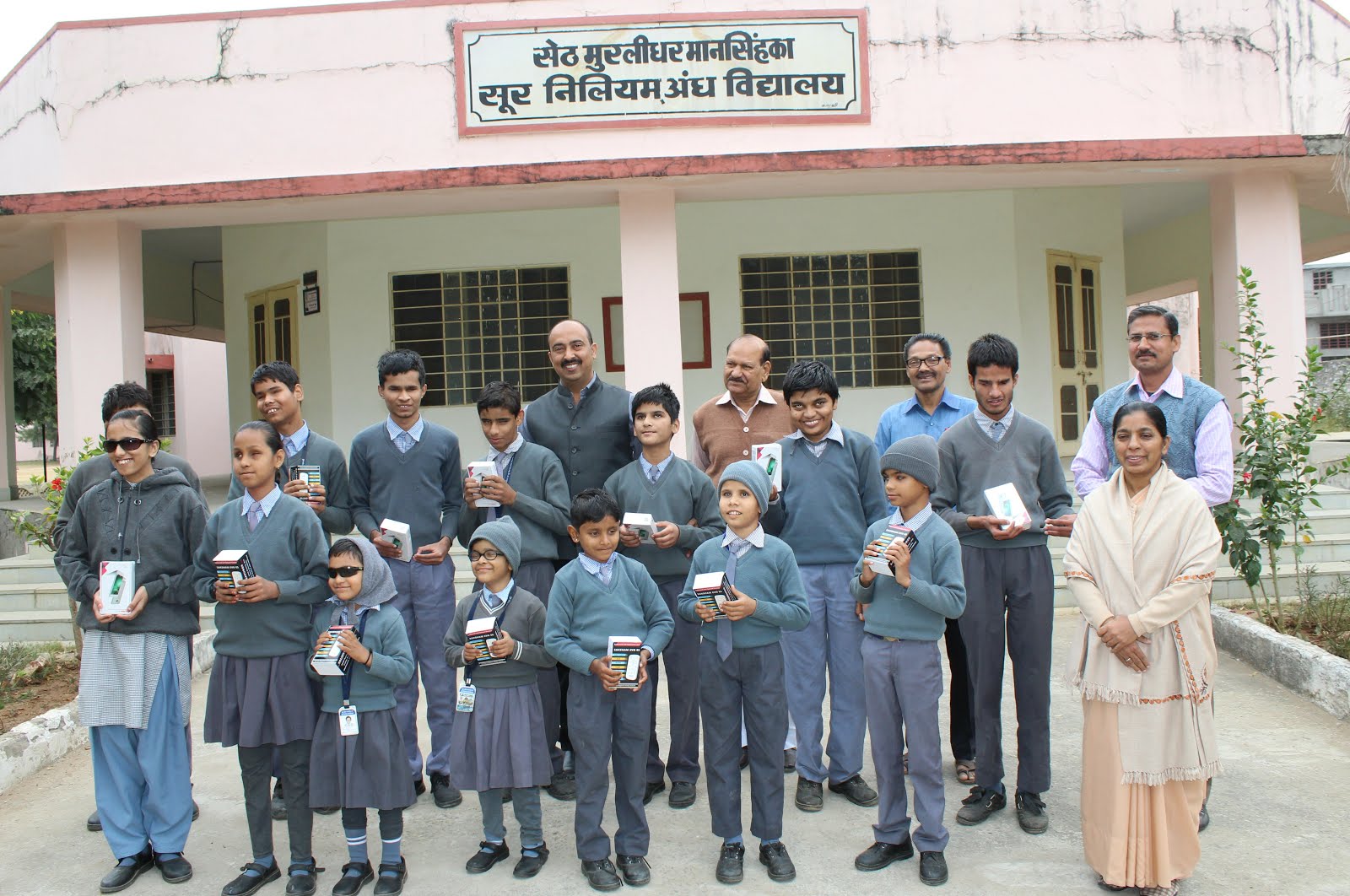
Many organizations are working consciously and tirelessly to ensure these children get their due attention. Through Jeevan Tarang, Hindustan Zinc has provided these Android phones to the students from Class 1st – Class 5th of Pragya Chakshu School, Udaipur and to all the students of Badhir Baal Kalyan Vikas Samiti, Bhilwara accessing them the basic human right to educate & learn, a critical step on the path to economic, educational, and social development. Hindustan Zinc has partnered with experts to build capacities of these institutions and under this initiative Mr. Nitin Patel has been appointed in both these schools as a trainer to train these students in these advanced gadgets.

The Chief Guest of the event, Amitabh Gupta – CFO, HZL expressed his happiness to see the passion of these students to learn and climb up the ladder of success. He emphasized that through Jeevan Tarang, Hindustan Zinc strives to provide better opportunities to these students to grow and learn.

Pavan Kaushik – Head Corporate Communication said “There is a need to understand and up-bring these children with all love and care. Jeevan Tarang is an initiative to ensure that every single ability & disability gets the same opportunities and recognition thus ensuring the development of both social & cognitive skills.”

‘Jeevan Tarang’ endeavours to support people with disabilities, with a focus to identify needs of deaf-mute, visually impaired and children with brain damages. Around 500 beneficiaries have been identified from HZL’s operational areas; Kayad Mine, Rampura Agucha Mine, Chanderiya Smelting Complex and Udaipur. 

VEDANTA KHUSHI - MINT - STATES SHOULD SPEND MORE ON NUTRITION

Greater fiscal autonomy has not yet translated into higher spending on nutrition by states

Malancha Chakrabarty September 11th, 2017
India’s record in addressing undernutrition is abysmal. With a stunting rate of 38.4%, India accounts for about a third of the world’s stunted children. Photo: AFP
Mohandas Karamchand Gandhi once said, “There are people in the world so hungry, that God cannot appear to them except in the form of bread.” Sadly, hunger and undernutrition continue to plague our country. India’s record in addressing undernutrition is abysmal. With a stunting rate of 38.4%, India accounts for about a third of the world’s stunted children. The proportion of wasted children in India increased from 19.8% in 2005-06 to 21% in 2015-16. Moreover, in states like Bihar and Madhya Pradesh, more than 40% of the children are underweight. Thus, nutrition should be high on India’s list of development priorities.
To be fair, India has a number of nutrition intervention programmes under different ministries. In absolute terms, India’s expenditure on nutrition schemes is quite high at Rs2.98 trillion but this is woefully inadequate if we take into account the level of deprivation in India.
Moreover, dramatic changes in the fiscal architecture based on the recommendations of the Fourteenth Finance Commission have raised serious concerns with regard to public spending on nutrition.
There has been a substantial decline in allocation for Central schemes. The Integrated Child Development Services Scheme (ICDS), a key scheme which provides basic education and health services to women and children below six years, suffered serious budget cuts. Allocation for ICDS declined consistently from Rs16,684 crore in 2014-15 to Rs15,489 crore in 2015-16 and Rs14,736 crore in 2016-17. Although 2017-18 saw an increase in the allocation for ICDS to Rs16,745.2 crore, this figure is only 0.5% higher than the actual expenditure incurred in 2014-15.
In the case of other schemes, like the Rajiv Gandhi Scheme for Empowerment of Adolescent Girls, also known as Sabla, and the Mid-Day Meal Scheme (MDMS), budget cuts were deeper. The outlay for Sabla declined from Rs622.4 crore in 2014-15 to Rs475.2 crore in 2015-16, and to Rs460 crore in 2016-17. In 2017-18, the allocation has been kept at the same level as 2016-17, which actually implies a decrease in allocation in real terms.
In the case of MDMS, there was a persistent decline in allocation from Rs10,917.6 crore in 2013-14 to Rs10,523.4 crore in 2014-15, and further down to Rs9,144.9 crore in 2015-16. In 2017-18, there was only a 3% increase in allocation, from Rs9,700 crore in 2016-17 to Rs10,000 crore. Again, the allocation in 2017-18 is lower than the actual expenditure of Rs10,761.4 crore incurred under the scheme in 2012-13. Even the 3% increase over last year does not mean much if inflation is factored in.
However, some Central schemes did witness an increase in allocation. The Maternity Benefit Programme, a conditional cash transfer to pregnant and lactating women to provide compensation for wage loss and adequate nutrition and rest, witnessed an increase in allocation from Rs634 crore in 2016-17 to Rs2,700 crore in 2017-18. The total cost of the programme up to 2019-20 is Rs12,661 crore for 5.17 million beneficiaries. However, nutrition experts regard this as inadequate because the number of beneficiaries under other schemes, notably the Janani Suraksha Yojana, was much higher at about 7.5 million, and that too in 2015-16.
Although the whole argument behind fiscal restructuring was that with more resources at their disposal, states would step up their expenditure, data on state budget allocation for nutrition schemes is not encouraging.
In fact, 2015-16 witnessed a decline in budget allocation in many states. In Uttar Pradesh, the total budget outlays for nutrition-specific interventions declined from Rs4,358.1 crore in 2014-15 to Rs4,054.9 crore in 2015-16, and subsequently increased to Rs4,573.3 crore in 2016-17. Budget outlays for micronutrient supplementation and deworming declined from Rs67.7 crore in 2014-15 to Rs58.9 crore in 2015-16, and Rs56.5 crore in 2016-17.
Similarly, in Odisha, the budget for nutrition-specific interventions declined from Rs1,188 crore in 2014-15 to Rs961 crore in 2015-16, and then increased to Rs1,302 crore in 2016-17.
In Bihar, there was a small increase in the allocation for nutrition-specific interventions, from Rs1,778 crore in 2014-15 to Rs1,972 crore in 2016-17. Rajasthan witnessed a modest increase in outlay for nutrition-specific schemes from Rs975 crore in 2014-15 to Rs1,022 crore in 2015-16 and Rs 1,106 crore in 2016-17. But budget allocation for nutrition-specific schemes in 2016-17 is 13% lower than the budget allocation in 2014-15.
Thus, greater fiscal autonomy has not yet translated into higher spending on nutrition by states.
Two critical questions emerge. First, can the Centre renege on its responsibility at a time when a large proportion of India’s children are undernourished?
Second, given that states have a greater responsibility, what can be done to ensure that they step up their allocation for nutrition?
While the former is an ideological question, here are some recommendations for the latter. Firstly, the Centre and state should work together to set nutrition targets for every state and district. Secondly, the Centre should play a more proactive role in monitoring the nutrition programmes of every state. Lastly, effective steps need to be undertaken to upgrade capacity at the state level.

Read On: http://www.livemint.com/Opinion/m4LD40v1SB6S4OOSs0FCoL/States-should-spend-more-on-nutrition.html  
Malancha Chakrabarty is associate fellow at the Observer Research Foundation.

HINDUSTAN ZINC’S JEEVAN TARANG INITIATES ‘GARV SE’ CAMPAIGN FOR SPECIAL CHILDREN


Mainstreaming the specially abled children by bringing them together with the society/community…

Hindustan Zinc under its ‘Jeevan Tarang – Zinc Ke Sang’ Project has initiated around six month long Campaign – ‘Garv Se’ where these Special Children of God would be participating in series of creative activities to engage them with Hindustan Zinc employees & their families on a same platform.
The program has been formally launched by Hindustan Zinc Ladies Club on 26th September, 2017 where Painting Workshop along with other artistic activities – clay modelling, diya painting & block painting were organized that saw the participation of around 60 children from Viklang Kalyan Samiti, Udaipur & Prayas Sansthan, Udaipur.

The objective of the Campaign is to mainstream the specially abled children by bringing them together with the society/community and Garv Se has been a step towards it by engaging Hindustan Zinc employees and their families through the series of engagements – movie screening, sports, trekking, dance workshops to name a few.

"Jeevan Tarang - Zinc Ke Sang” was formally launched on Foundation Day of Hindustan Zinc, i.e., on 10th January, 2017.

The fact says that there are over 70 million disabled people in India out of which over 12 million are hearing impaired with hardly 500 government aided Deaf schools providing formal education to these children. Even the teachers working in these schools are not equipped or trained to teach the hearing impaired students as Sign Language is still not accepted as a medium of teaching and communication. More than 90 % of students with deafness do not have access to and are out of the formal education system. Lack of access to language has also kept the deaf away from development of social and cognitive skills.

Mr. Pavan Kaushik – Head Corporate Communication said “There is a need to understand and up-bring these children with all love and care. Jeevan Tarang is an initiative to work towards a more inclusive society, where every single ability & disability gets the same opportunities and recognition.”

‘Jeevan Tarang’ endeavours to support people with disabilities, with a focus to identify needs of deaf-mute, visually impaired and children with brain damages. Around 500 beneficiaries have been identified from HZL’s operational areas; Kayad Mine, Rampura Agucha Mine, Chanderiya Smelting Complex and Udaipur. Access to knowledge is a basic and human right, a critical first step on the path to economic, educational, and social development. Hindustan Zinc has partnered with experts to build capacities of these institutions.

Hindustan Zinc has also partnered with National Handicapped Finance & Development Corporation to support for Skill Building of the disabled persons from among Hindustan Zinc’s districts. 


Also present were Ms. Neelima Khetan – Head CSR, HZL, members of Hindustan Zinc Ladies Club along with HZl employees and their families during the program.

VEDANTA KHUSHI - JEEVAN TARANG - SPECIAL CHILDREN TO GET SPECIAL ATTENTION BY HINDUSTAN ZINC

Jeevan Tarang – Zinc ke Sang - to enhance education and skill opportunities of more than 500 children with disabilities…

There are few children that god has made with lots of love, affection & care and this is the reason, these children are known as 'special children of God'. These children make you smile instantly and also brings tears in our eyes. As these are special children,  they do require and need a lot of care and attention.  
Many organizations are working consciously and tirelessly to ensure these children get their due attention. “Jeevan Tarang” is a unique initiative launched by Hindustan Zinc, a Vedanta Group company with an objective of enhancing education and skill opportunities for the disabled, and mainstreaming them into the society. Under the program, around 500 beneficiaries have been identified from Hindustan Zinc’s operational areas by working with schools for deaf-mute, visually impaired and for children with brain damages in Ajmer, Bhilwara, Chittorgarh and Udaipur.
"Jeevan Tarang - Zinc Ke Sang” was formally launched on Foundation Day of Hindustan Zinc, i.e., on 10th January, 2017.
On 30th August, 2017, on Zinc Day, Children of Jeevan Tarang from Shri Sanwaliya Bahuuddeshay Viklang Seva Sansthan (SSBVSS), Chittorgarh, Baadhit Baal Vikas Samiti, Ajmer, Viklang Kalyan Samiti, Udaipur and Badhir Baal Vikas Kalyan Samiti, Bhilwara performed during the cultural evening and enthralled the audience with their beautiful heart touching performances.
During the program, Hindustan Zinc also partnered with Noida Deaf Society(NDS) to develop a long-term vision and roadmap for the institutes of Deaf-Mute children. NDS has set up four permanent separate trainers (Deaf Mute themselves) who will teach Indian Sign Language(ISL) to students. Jeevan Tarang  also focuses on capacity building of teachers by teaching them ISL, who then will be equipped to teach the courses in ISL. Through this partnership, the aim is to enable 400 children learn sign language so to empower the children by imparting education and vocational training for rehabilitation of hearing and speaking impaired children, instilling self-confidence and skills & qualitatively improve both their professional and personal potential to be an active contributor to society.
During the program, Mr. Sunil Duggal – CEO, HZL said “The need is to up-bring these children with all love and care. After all they are special children of god and through Jeevan Tarang we strive to provide them with better opportunities to grow and learn.”
The fact says that there are over 70 million disabled people in India out of which over 12 million are hearing impaired with hardly 500 govt aided Deaf schools providing formal education to deaf children. Even the teachers working in these schools are not equipped or trained to teach the hearing impaired students as Sign Language is still not accepted as a medium of teaching and communication. More than 90 % of students with deafness do not have access to and are out of the formal education system. Lack of access to language has also kept the deaf away from development of social and cognitive skills.
Mr. Pavan Kaushik – Head, Corporate Communication said “Jeevan Tarang is an initiative to work towards a more inclusive society, where every single ability & disability gets the same opportunities and recognition. Hindustan Zinc has partnered with experts to build capacities of these institutions and also engaging industry representatives to ensure good job opportunities for them.”

Also present were Mr. Ashwin Bajaj – Director, Investor Relations, Vedanta Group, Mr. Amitabh Gupta – CFO, HZL, Mr. Naveen Singhal – Head Projects, HZL, Mr. L.S. Shekawat – COO, Mines, Mr. Pankaj Kumar – COO, Smelters, Mr. Ramakrishnan Kasinath – Chief Commercial Officer, HZL, Mrs. Sonal Shrivastava – Dy. CFO, Mrs. Neelima Khetan – Head CSR, HZL, Mr. V. Jayaraman – Head EOHS, Ms. Ruma Roka – Founder of NDS and other HZL representatives during the program.

VEDANTA KHUSHI - VEDANTA READIES RS 400-CR FUNDING FACELIFT FOR ANGANWADIS

The Vedanta Foundation, the philanthropic arm of metal and mining major Vedanta, will revamp 4,000 anganwadi centres across India by equipping them with TVs, solar panels and toilets.
The foundation will fund the modernisation drive with over Rs 400 crore, for which it has partnered with the Ministry of Women and Child Development (WCD), it said in a statement.
The first model Anganwadi, Nand Ghar, was inaugurated by Union Minister for WCD Maneka Gandhi today, along with Vedanta Group Chairman Anil Agarwal, at Hasanpur village in Sonipat district of Haryana.
Inaugurating the centre, Gandhi said: "This Nand Ghar model will provide targeted delivery of supplementary nutrition services, along with related healthcare services for both mother and child, including skill training for women."
The Minister hailed Vedanta's efforts in this regard.
"The Ministry of WCD and the Vedanta Group have come together to construct 4,000 Anganwadi buildings in different parts of the country. Nand Ghar is an extension to the existing anganwadi initiative and will be Vedanta Group's endeavour to provide better environment to children of India," said Agarwal.
Vedanta's Nand Ghar project aligns with Prime Minister Narendra Modi's vision and commitment to providing quality education for children and skill development for women in the entire country, he added.
The Vedanta Foundation has already collaborated with over 3,000 anganwadi centres in Rajasthan and Odisha by supplementing the services of the government and addressing the nutrition as well as the educational needs of over 1 lakh children. 

VEDANTA KHUSHI - BE POLITE TO THE CHILDREN OF STREET, SAYS “KHUSHI”

I was travelling from Bangalore to Delhi in Karnataka Express. With fatigue of travelling almost 40 hours in train, with tons of baggage, it was quite an irritating and hectic journey. The time I got down on Delhi Station with all my baggage, a child not more than 6-7 years started pulling my shirt and started asking for money. As my hands were full of luggage and had a bag on my shoulder, I was getting terribly irritated. In all this push and pull my bag fell down and it opened. Everything inside the bag was on road. This was enough to push my patience and my hands did the rest.

Everyone who passed looked at me with anger and disgust. No one helped me. Rather everyone sympathised with the little child.

Though I left the Railway Station, that guilt of letting lose my hand stayed with me. From that day whenever I see a child begging I experience that guilt. Today, after almost 24 years, when I am attached with Vedanta’s “Khushi” campaign - for the underprivileged children in India, for their education, nutrition and health, I feel I am doing a bit for myself and for my country. My guilt has been now converted into energy.

The very first line that “Khushi” wrote to its members was ‘be polite to the children of street – they are not on street by choice but by force’.

With largest child population in the world and almost 1/3rd of world's malnourished children living in India, our country has to find a future for these crores of children. 

”Khushi” encourages individual efforts are what the country needs today.  Government, NGOs and Corporates cannot do it alone.

With about 50,000 members in the “Khushi” group on facebook from across the world, many want to donate money. But “Khushi” is not about donating money, but for donating time. Donations are not encouraged or accepted.


I am sure, many of you must be carrying some feeling for the underprivileged children in India. Here it is a chance to put value to life.. Join “Khushi” – www.facebook.com/groups/vedantakhushi

VEDANTA KHUSHI - LAKSHMI GOT SURPRISE GIFT OF HER BOOKS-NOTEBOOKS TODAY..

Lakshmi’s father works as car cleaner and has been cleaning many cars, including ours. A  work that he starts early morning. He is determined to educate his daughter, Lakshmi, and wants her to study till she wants. He has a cycle and daily drops Lakshmi to school, though the school is not far from his house. He proudly says, ‘I will clean more cars and do other work sir but education of Lakshmi will not stop’.  

We have been asking him about the education of his daughter since the final school result had come-out. He informed that she has passed satisfactorily and is now in class-I. After repeatedly asking, Lakshmi father informed that he has not been able to get the books for his daughter due to sudden expenditure pressure. May be he would buy after the summer vacations and till than he would save money.

Lakshmi has been asking for books from her father almost daily. Carrying empty bag to school, for a child who is keen to study, is very disappointing and discouraging, he informed.

My fear was that in all this financial crunch education of Lakshmi should not be left and the school should not remove her from the school.

This is when we decided to buy school books and other school items to Lakshmi so that she is sure of her continuation of school.

Adhering to the “Khushi” philosophy, giving cash was never considered. So I decided to go to the school myself, call Lakshmi and accordingly buy all the books and notebooks to her.

Today perhaps was the day. Lakshmi was called by the Administration Head of the school and she came with an old water bottle and an empty school bag. Neatly dressed she was quite, wondering what is in store for her. I told her that she would get books and notebooks and all other things that she requires to get good marks right now.

Lakshmi smiled and smiled and smiled.. also wondering why I was buying for her.

I requested the Administration Head to kindly get the books-notebooks. Lakshmi constantly kept looking at the Office Assistant who was to get the books. Honestly, the books did not cost much.

The Principal of the school asked me, ‘how was I related to this matter’. I explained him the objective of Vedanta’s “Khushi” and told him that ‘I did because I could’. ‘Someone else would also do, if he could too.’ 

I experienced a satisfaction of doing something for a needy child who wants to study.. and for Lakshmi, it was a bright “Khushi” on her face, a priceless “Khushi”. 

VEDANTA KHUSHI - VEDANTA ADOPTS 3056 ANGANWADI CENTRES IN RAJASTHAN


1000 Anganwadis in Rajasthan to be converted into Model Anganwadi Centres

Government of Rajasthan, Hindustan Zinc (a Vedanta Group company) and Vedanta Foundation today signed a Memorandum of Understanding (MoU) under the Integrated Child Development Services (ICDS) to adopt 3056 Anganwadi centres in five districts of Rajasthan - Udaipur, Chittorgarh, Bhilwara, Rajsamand and Ajmer for 5 years. This adoption will benefit more than 90,000 underprivileged children in the age group of 3-6 years and will contribute significantly towards their overall development that would include nutrition, education and primary health.

As part of further strengthening of these Anganwadi Centres, Hindustan Zinc and Vedanta Foundation would also convert 1000 Anganwadi Centres into model Anganwadis. This project would also be spread across a period of 5 years, and in each year 200 Anganwadis would be converted into model Anganwadis.  In these selected Model Anganwadi Centres, Hindustan Zinc and  Vedanta Foundation will carry out repair & renovation of the building, construction of child friendly toilets, story painting on inside wall, provide water filters, daris and swings. Uniform will also be provided to all the enrolled children.

All the Anganwadi Centres will get clean drinking water, new utensils and smokeless chulha for the kitchen. Supplementing morning breakfast, poha and groundnut will be provided.

Pavan Kaushik, Head of Corporate Communication, Hindustan Zinc, informed that “our focus is on overall growth and development of these rural children. Colorful books & charts, toys and other pre-school educational material will be provided by the company to encourage interactive play-way method. Hindustan Zinc will also provide special training on pre-school education to the Anganwadi workers of the all these Centers and to our own field coordinators for better coordination, understanding and learning.”

As per the new WHO guideline, adopted at all selected Anganwadi centers, digital weighing scale and hygiene up-keep items like hair oil, talcum powder, hand wash shop, phenyl and detergent will be provided. Special emphasis will be given to health & hygiene and weight measurement of these children.

Vedanta Group has a strong focus towards care for the underprivileged children. Mr. Anil Agarwal, Chairman – Vedanta Group has set his vision to make India a child malnourished free nation.

Since 2008 the Group has been associated and supported about 14,000 child care centers in Rajasthan, Karnataka, Chattisgarh, and Odisha reaching about 500,000 rural children – for their nutrition, health and education. Incidentally the first MoU on adoption of Anganwadi Centres by Vedanta Group company Hindustan Zinc was also signed about 7 years back in the presence of Rajasthan Chief Minister Smt. Vasundhara Raje and Chairman of Vedanta Group, Anil Agarwal.

Vedanta had launched campaign “Khushi” that sensitizes common people towards care for the underprivileged children and take-up individual steps for such cause. The campaign is first of its kind ‘Non-Funding’ campaign which has more than 45,000 members across the globe on facebook. “Khushi” itself has 75 child-care Centres across India benefiting directly to about 2500 underprivileged children. Hindustan Zinc and Vedanta Foundation will be executing this project under “Khushi” campaign.

The MoU was signed today by Tribhuvan Pati, Additional Director (ICDS) from Government of Rajasthan and by CSR Mehta, Head-Corporate Relations, Hindustan Zinc. Also present on the occasion were Smt. Anita Bhadel (Independent Charge), Women and Child Development and Dr. Gurjot Kour, Additional Chief Secretary(WCD), GoR, Jaipur.

VEDANTA KHUSHI - TIMES OF INDIA - 1 IN 5 PRIMARY TEACHERS UNQUALIFIED


NEW DELHI: A fifth of all elementary school teachers in the country do not have the requisite qualifications to teach young children. If this doesn't shock you, take a look at what's going on at the state level. 

In a wide swathe starting from all eight states of the North-East (including Sikkim), through West Bengal, Bihar, Jharkhand, Chhattisgarh, Madhya Pradesh and up north in J&K, the share of qualified teachers is much lower, ranging between 29% in Arunachal Pradesh or 30% in Nagaland to 68% in MP and 70% in Jharkhand. It is through these untrained hands that the foundation of education is being laid in children. 

What is even more worrying is that according to district information system for education (DISE) - it's a school education database managed by the National University for Educational Planning - this condition has persisted for past many years. 

In larger states 90% or more teachers are professionally qualified. In Odisha, the proportion is 79% while in Uttar Pradesh it is 78%. Karnataka (96%) and Punjab (88%) show decline in proportion of qualified teachers. 

It's essential that teachers, especially of smaller children, be professionally trained, stresses Anita Rampal, professor at Delhi University's department of education. 

"Just knowing a subject or being a graduate is not sufficient qualification to become an elementary school teacher. You need to be trained in understanding the learning process of children, their diversity, and you need to develop necessary teaching skills under trained supervision," she said.

The situation in the eight North-Eastern states has been like this for many years. Elementary schools in Assam, the biggest state of the region, are running on just 39% trained teachers, virtually the same share as in 2006-07. Arunachal Pradesh has slid from having 35% trained teachers in 2006-07 to 29% now while Mizoram is facing a calamity - its share of trained teachers has plummeted from 61% in 2006 to 40% currently. Tripura and Sikkim have seen improvements, but at a worryingly slow pace. 

Bihar has one of the lowest shares of trained teachers, because teachers training colleges remained closed for about a decade, says Rampal, who explains the condition in North-East as arising from lack of teachers training colleges. In 2006-07, the share of qualified teachers in Bihar was 62%, which has now reduced to 43%. In West Bengal, too, the situation is fast sliding as the share of qualified teachers went down from 75% in 2006-07 to 49% in 2013-14. 

In Chhattisgarh, with 59% share of qualified teachers, and in Jharkhand with 70%, there has been only a marginal improvement in the past seven years. A similar situation exists in J&K where only 51% teachers were qualified in 2006-07 and now this share is 52%. 

School education is in the concurrent list of the Constitution with both, the states and Centre having power to deal with it. A large proportion of funds are provided by the Centre through the Sarva Shiksha Abhiyan, a centrally sponsored scheme. The regulation of teachers' qualification is done by a Central statutory body, the National Council for Teachers' Education. While it is mandatory for states to appoint qualified teachers to schools, clearly, the law is being brazenly flouted. 

The trend towards appointment of contractual or para- teachers which acquired great popularity through the 1990's has also contributed to the decline in teachers' qualification standards, experts believe. 

Vedanta Khushi : I Can – My Father Can’t

(a heart touching story)
This incident is a little old. Dharmendra, a small farmer from Amara, Uttar Pradesh, has a small piece of land on which he cultivates seasonal crops, sometimes vegetables. His family has 4 people, his wife and 2 children, elder girl Radha is aged 12 and the son Cheeku is of 7 years. As the land is small he is comfortable cultivating himself and if required his wife helps him out.
The village is quite remote and children are not encouraged to go to school. This is the reason that he and his wife, both remained illiterate. The land holders took away almost half of Dharmendra’s land by forging documents.
But children are children, as they play together they also mingle for seeing pictures in the books of children who were going to school, though very few in number. This interaction helped both his children learn few alphabets and few words. Their interest in education was quite evident. But both the children never told about this to their parents.
After heavy rains, the village had a number of cases of viral fever. It was spreading in almost every house. Dharmendra was worried as his wife and son had caught viral fever too. The village doctor visited almost every house and gave medicines, with dose and frequency written on a slip. Dharmendra had arranged these medicines in such a way that it became easy to identify through positioning as he could not read a word, neither anyone within the family.
But destiny is destiny. In the night heavy showers and wind mixed packets of medicine. It was not possible to check with doctor because of heavy rains. Taking a chance, he asked his daughter Radha to get water to give medicine to the mother and son. The over-dose of medicines reacted and soon the mother and son started vomiting. Their condition became serious. Dharmendra ran to the house of doctor and brought him on his cycle.
As the doctor saw the condition and medicine he became very angry and slapped Dharmendra.
Whole family being illiterate had almost costed 2 lives.
Radha also started crying.
With great difficulty doctor was able to make both mother and son stable.
Dharmendra was ashamed of what had happened and could have happened.
He decided to break the rules set by his ancestors on education and very same moment decided to send his both children to village school. As the rains stopped and the viral retracted, he got his both children admitted to school.
Radha, though should have been in class 8th if she had gone to school regularly, is now in class 4 and his son Cheeku is in class 2nd.
When Dharmendra goes to school to meet teachers, he puts his thumb-impression, but when it comes to Radha and Cheeku, they both sign their names.
Radha is simple and humble, but Cheeku naughty and teases, look “I Can but My Father Can’t” sign.
**Not necessary we have to give importance to education only when we face drastic circumstances. Education is not just learning, it also silently teaches moral values.

Vedanta Khushi : Join “Khushi”, Raise Your Voice towards Child Care


Vedanta's “Khushi” campaign is a mission driven by the vision of Mr. Anil Agarwal, Chairman – Vedanta Group’s that “no child in India should remain malnourished and be deprived of education and primary health. Let India be a child malnourished free nation.”  Join "Khushi" and raise your voice and concern towards child care in India.

India,  a  country  with  largest  child  population, largest malnourished children, largest child deaths, and largest street children in the world, put our  minds  and  thoughts  in  a  thinking-hat  mode.  For once, we felt apprehensive about building India for a bright and progressive future. It was sure, government, NGOs, corporates alone cannot bring this problem to a solution and common masses need to align and join on such national missions.

This is where we decided to launch an awareness campaign “Khushi”, which was aimed to spread the message of care for the underprivileged children and building a life of dignity for them.  The message was clear that about 50% of India’s child population needs attention – attention towards their nutrition, education and good health. The message was also clear that without the involvement of similar minds, India would never be able to make it to a developed nation. 

On this thought, on 10th April 2012, Vedanta Group launched “Khushi”, on blog and on the Facebook.  We also decided to make “Khushi” a 100% non-funding campaign that would strongly engage with people and spread awareness to encourage them to take individual steps and initiatives towards child care.

Where the blog, www.khushi-creatinghappiness.blogspot.in, became a platform for   encouraging   people  by  uploading  success  stories,  articles  and  statistics;  the  Facebook  group, www.facebook.com.groups/vedantakhushi, became  a  platform for on-line discussions and debates and spreading  awareness. By now, on “Khushi” group, about 60 debates have been carried out on a number of issues like girls’ education, infrastructure in schools, problem of street children, beggary, quality of education, rehabilitation, disparities in urban and rural education, sending underprivileged children back to school,  malnutrition, corporal punishments to children, child labour making crackers,  effects of TV advertising on children, portray of Indian Children in Cinema,  mobile phone and their effects on Children,  Safety of Children etc.

The debates have also become a platform for knowledge sharing and a guiding factor for proposed actions. Taking forward the outcomes from debates, Vedanta adopted 112 schools  in Rajasthan for completely changing their infrastructure, study material and other facilities. 

To further strengthen the objective of “Khushi”, 75 child care centres have been adopted in Tamil Nadu, Odisha, Rajasthan and Chattisgarh. These centres have about 2500 deprived and underprivileged children.  These children are provided daily nutritious breakfast, lunch, books and primary health check-ups. 

Vedanta “Khushi” also spent days with the street children to understand their issues and problems. Accordingly, workshops were conducted to inculcate the importance of education, health and hygiene, nutrition and behaviour change.

Recently, Vedanta’s “Khushi” came together with NDTV for the girl child campaign – Our Girls Our Pride.  The campaign ambassador was the gorgeous bollywood film actress Ms.  Priyanka Chopra.   Ms.  Krishna Poonia, the Padamshree, and the ace international athlete also became joined “Khushi” campaign.

Today,  when we are about to complete 2 years in this mission (10th April 2014), we are quite pleased that we are able to communicate our message clearly to a number of opinion makers which include journalists, professors, engineers, social  workers,  bureaucrats,  students,  doctors,  management graduates, entrepreneurs, etc.  

Vedanta “Khushi” has become a global mission and there has been increasing interest from Indians living in different parts of the world. People are engaged and spreading message of child care through direct engagement with people and also through their social media presence. 

One thing we could successfully bring forward through "Khushi" has been change in the behaviour of people towards deprived children.

Vedanta “Khushi” is growing every day and so changing the society.

Vedanta as a group has worked so far with 14,000 child care centres in India – in the state of Rajasthan, Karnataka, Chattisgarh, and Odisha, reaching out to more than 500,000 deprived and underprivileged children, since 2008.

Taking cognizance of the issue, Government of India has sanctioned Rs. 129,000 crore in the current plan to be spent under the Integrated Child Development Scheme (ICDS) within 3 years.

Vedanta Khushi : ET Article : The National Fight Against Malnutrition

Veena S Rao 
10th March 2014

The periodic public outcry over India’s malnutrition and hunger has curiously stopped despite repeated reports confirming the alarming situation. However, a welcome development is that political parties have raised the issue in the run up to the polls, recognizing nutrition as a determinant of development.

The perception among nutrition experts and NGOs has changed. The ICDS is no longer seen as a vehicle to tackle malnutrition. Rightly, the focus has shifted to an inter -sectoral approach, but the discourse gets stuck at this point. Without a national programme with an inter -sectoral template, no one including the government seems to know how exactly to intervene inter- sectorally. Many institutions are unable to address the problem on the ground, without a design or format to guide them. 

National programmes with a well defined structure such as the Sarva Shiksha Abhiyan, Midday Meal Programme or the National Rural Health Mission provide a fulcrum for NGOs to offer support without complication. The absence of a national programme to fight malnutrition denies such a platform, and results in an information void on what interventions are essential, and how best to undertake them. Hence, apart from organizing occasional conferences and “advocacy”, mostly on isolated themes, there is no concerted strategy on the ground to effectively address malnutrition afflicting people across age groups.

Public awareness and information on social and development issues is generated through strong national programmes. They become the strongest advocacy tools, taking the message to the grassroots, notably health, education and women empowerment programmes.

Information and awareness on malnutrition has no such medium, leading to the vacuum in information at the grassroots within families, communities, PRIs and field staff of NGOs and government on critical issues: preventing child under-nutrition, proper maternal nutritional care to ensure adequate weight gain during pregnancy and prevent low birth-weight babies (first casualties to neonatal mortality) and nutritional care of adolescent girls (the most undernourished in the world), who are future mothers. 

Lack of information and awareness cascades further into the absence of capacity creation at all levels and stages of the participation/implementation process and, more importantly, in the absence of demand for nutritional services from the afflicted population. This is why there are hardly any think tanks, research or capacity-building institutions at state or district levels. Also, there are no journals or information in local languages on the subject to educate people, and not even vernacular equivalents for terms like “body mass index” or “chronic energy deficiency”. 

Neither is there an enabling environment for a united and vocal nutrition lobby with strong leadership to influence government. There is negligible presence of public health/nutrition in research institutions in state capitals and none at all in district/ block institutions, where the action really lies. Besides, the nutrition lobby is disunited, often deflecting attention from the urgency of addressing malnutrition holistically. A strong, united nutrition lobby, providing innovation and working models, could have influenced the government to announce a national programme to address malnutrition. 

There is despondency about the governance environment to address malnutrition: lack of information and capacity among stakeholders, particularly the community, lack of demand and ostracism of the private sector that has a mandate to address malnutrition under new CSR norms. Old schemes and the army of Anganwadi workers are also a baggage for government. Instead of innovation, the creaking Anganwadi is being saddled with more activities, but sinking under the malaise of contractors, commissions and corruption. 

A comprehensive strategy to address malnutrition is perfectly doable. The Karnataka Nutrition Mission has piloted this, based on inter-generational, inter -sectoral interventions, bridging the dietary calorie-protein micronutrient gap, initiating grassroots awareness programmes and rigorous real-time monitoring, with encouraging results. Political parties must give top priority in their election manifestos to fight India’s malnutrition through a strong national programme. 

The writer is a former civil servant

Vedanta "Khushi" Blog Crosses Half-Million Page Views

Vedanta "Khushi" mission is a journey we all started together about 2 years back in the month of April 2012.  The challenge was to bring forth the most sensitive and critical social issue of India, the care for the underprivileged children, their nutrition, health and education. 

The Campaign is driving the vision of Mr. Anil Agarwal – Chairman, Vedanta group, that “No Child in India should remains Malnourished and be deprived of Education, Nutrition and primary Health Care.  Ultimately, India should be a malnourished free nation."

To promote success stories of various individuals/members and starling statistics from various national and international reports towards child care, we developed an in-house Vedanta "Khushi" blog - www.khushi-creatinghappiness.blogspot.in and started uploading such stories. These stories became an ultimate medium of motivating others for similar action.  

We are quite pleased to inform you that the Vedanta "Khushi" blog has crossed a half-million page views mark today. 

As we say, Vedanta "Khushi" mission has this thought that government, corporate and NGOs together cannot do it all and there has to be a direct participation from common people.  People need to be sensitive towards the issue & concern and participate equally for its prevention and cure.

Khushi has a strong base on facebook with over 36,000 volunteers from across the globe -www.facebook.com/groups/vedantakhushi.  Several members have gone ahead and helped these underprivileged children at their own level.

The campaign has been successful in connecting people of similar minds and thoughts throughout the world.

We all know “Khushi” cannot be bought, begged or borrowed; it has to come naturally….

We thought of sharing this news with you all..