Gurukshetra Stories and Incidents

M/s Gurukshetra Consultancy has focus on strategic communication (Advocacy), Promotors, senior Leadership and CXOs image & positioning, aligning Corporate Social Projects with corporate objectives and streamlining internal communication of corporate structure. M/s Gurukshetra Consultancy is all about defining unlimited contribution and scope of Gurus of Corporate World towards positioning industry, society at large and the country, their Kshetra. Gurukshetra would also feature success stories of CXOs and professionals - people who matter and are Gurus of their own Kshetra.
Showing posts with label Child Malnutrition in India. Show all posts

VEDANTA KHUSHI - INDIAN EXPRESS - ANGANWADIS: A REPORT CARD

By Shradha Chettri | New Delhi | Updated: June 19, 2017 
The Indian Express visited 14 Anganwadis, and found similar problems almost everywhere...
A healthy meal and a stepping stone for school — anganwadis in the city have two key responsibilities. The Indian Express explores the problems at each front.
Five-year-old Naseem does not go to school, but that doesn’t mean he can stay at home after breakfast. As soon as the clock strikes 9 am, Naseem leaves home, unenthusiastically dragging his feet across a small drain filled with plastic. He eventually reaches a small room on the ground floor of A block, New Seemapuri, in northeast Delhi.
Six others, some younger than Naseem, are already there, with an old fan and a rug to keep them comfortable. A few tattered charts with alphabets and numbers hang on the wall.
Naseem is greeted by his teacher (officially a ‘worker’), a woman in her 30s. She marks him ‘present’, and he sits down to play with the plastic toys scattered on the floor.
He spends the next four-and-a-half hours at the anganwadi centre (AWC), which is supposed to provide him supplementary nutrition and prepare him for Class I. But his mother, Shabana, has a grouse: “He has been going to the anganwadi for over two years. Forget learning the alphabets, he still doesn’t know how to hold a pencil, or colour.”
The Indian Express visited 14 anganwadis, and found similar problems almost everywhere.
Shabana still sends her son to the AWC because that is the only time she gets to do tailoring work. Her husband is a daily wager. The couple have three other children — two study in a nearby municipal school and one in a Delhi government school.
As Naseem plays, another woman walks in holding two children, aged three and four, by their hands. She makes them sit alongside Naseem. She is a ‘helper’ at the AWC, responsible for bringing children aged six and below from the neighbourhood to the centre — under the Integrated Child Development Services (ICDS) Scheme.
Hard to swallow
The ICDS — under the Ministry of Women and Child Development, and looked after by the WCD department in each state — has been in place since 1975. It was restructured under the 12th Five-Year Plan to ensure holistic development of children aged six and below.
The aim was to reduce anaemia and child mortality rate by giving supplementary nutrition — especially to malnourished children — and to improve early learning outcomes.
Naseem’s teacher is meant to keep children engrossed till 12.30 pm, when food arrives. She makes them narrate a poem, but eventually they get fidgety and say they want to go home. The two women assure them they will get food soon. Eventually, men carrying two steel containers walk in around 11 am.
The food is to be distributed to children up to six years and pregnant and nursing mothers in the neighbourhood.
Today, the meal comprises pulao and salted chana (black gram). While there’s a different meal every day (see box), the snack alternates between black chana and white matar. The children — there are 6,97,158 in anganwadis across the city — know each day’s menu by heart. Even before the helper lifts the lid, Naseem says,“Aaj toh pulao milega. Mujhe toh sirf meetha dalia acha lagta hai, jo kal milega.”
The children line up with bowls. Some sit and eat, while Naseem runs home with the food. He keeps it in the kitchen and asks his mother for lunch. “Many children don’t like the food at the anganwadi. Naseem usually comes home and eats lunch,” says Shabana.
Sarita Dhariwal, a worker at an AWC a few blocks from Naseem’s home, explains why: “It is impossible to eat this rice. The chana has no salt. But children still eat the food because there is no one to cook for them.” Dhariwal, who has been at the centre since 2012, says the quality of food has deteriorated with each passing year. “It is only when there is news of an inspection that the quality improves,” she says.
Insufficient staffers
The food at the AWCs is supplied by non-profit organisations (NPOs) empanelled by the WCD department. There are 22 in the city and work is allotted through a tendering process. Each kitchen prepares food for 30-40 anganwadis.
The meal is supposed to provide 500 calories and 12-15 grams protein to children aged between 6-72 months, and 600 calories and 18-20 grams protein to pregnant and nursing mothers.
Dhariwal says she has raised the matter with her supervisor and the Child Development and Project Officer (CDPO). Since there are only 37 CDPOs for 95 projects, an officer cannot visit each centre under her daily, which means quality tends to slip. “Apart from visiting the centre, we also have a lot of administrative work. It is not possible to keep a record of every centre,” says a supervisor in south Delhi, who did not wish to be named.
There should be one CDPO for each project, but most positions haven’t been filled for years.
Deputy Chief Minister Manish Sisodia, who recently took additional charge of the WCD department, acknowledges the problem. “As services are no longer under the jurisdiction of the Delhi government, it has become difficult to appoint officers,” he says. For now, the minister has asked DANICS and ad hoc IAS officers to visit two anganwadi centres on Saturdays.
With few takers, most of the food at anganwadis in Sangam Vihar — one of Asia’s largest unauthorised colonies — is often thrown away. There are frequent complaints that the anganwadis have been serving the same snack every day. “Children get tired of eating the same thing. Since we have to keep them here till 12.30 pm, I buy biscuits for them,” says Suman Lata, a worker at AWC No. 100 in Hamdard Nagar.
Just like at her anganwadi, most other centres only have 10-15 children registered. Lata acknowledges that the number of children in the neighbourhood is far higher.
Former chairperson of the child welfare committee, Raj Mangal Prasad, says, “The government had decided that commercial ventures will not supply (food) and that work will be given to NPOs. But, ultimately, these commercial ventures started NPOs. The profit in food distribution is huge. Then there are supervisors who work with these NPOs, so monitoring quality has been a huge challenge.”
Each AWC gets food based on the number of children and women registered. NPOs are paid Rs 6 per day to supply meals for children below six years, Rs 9 per day for malnourished children, and Rs 7 per day for pregnant and nursing mothers.
A learning issue
Like Shabana, many other parents The Indian Express spoke to shared concerns about their children not learning enough.
Anganwadis are ideally supposed to serve as Early Childhood Care and Education (ECCE) centres, with Sisodia bringing in a fixed curriculum to be taught to children. By the time children leave the anganwadi, they should know the names of colours, seasons and learn how to write letters and numbers.
Four-year-old Rehan at anganwadi No. 104 in New Seemapuri plays with an alphabet cube, but doesn’t know what it is. “Mujhe nahi pata ye sab kya hai,” he says. The helper brushes it off, saying Rehan is not regular.
But Rajiv Kumar of local NGO Pardarshita says the problem with most anganwadis is a dearth of workers responsible for teaching.
“Helpers are supposed to collect children and serve food, while workers do the teaching. But many positions are lying vacant,” he says.
At Rehan’s AWC, too, the worker has been on leave for a while now. That many anganwadi employees haven’t been paid for as long as four months doesn’t help. A worker gets Rs 5,000 a month, while a helper makes Rs 2,500.
“When we ask supervisors, they say we will be paid soon. If they expect us to work properly, they should also pay us,” says a worker at a centre in Lal Kuan.
Those who are regular complain that they haven’t been trained enough. “The government sends new guidelines and course sheets, but we don’t get training. We have to know how to teach children. Some workers have not been trained in the last 10 years,” says Kavita Chauhan, an anganwadi worker at Lal Kuan.
Chauhan, who studied till Class X, was hired as a worker in 2012. She was trained for a week when she joined — and that was about it. During training, they were taught how to fill registers, weigh children and maintain a record of malnourished kids.
How well that data is maintained is another story. Sunita, a resident of E-block in Sunder Nagri, says that when her daughter was three years old, she weighed just 3.7 kg — much below the WHO standard of 10.7 kg.
Sunita, whose daughter is now six, says she used to visit the AWC near her home to weigh her child and get vaccinations. But no one told her the child was malnourished. When NGO Pardarshita conducted a survey between 2013 and 2014, they found the child needed immediate medical attention and took her to the hospital. Till date, she has not fully recovered.
Of the 580 children weighed in just one block in Sunder Nagri, 65 were severely malnourished and 131 were malnourished. This is in stark contrast to a monthly report of the WCD department across the city during the same
period, which showed only 201 children aged six or below were malnourished. “Anganwadis don’t have proper weighing machines… Many provide inaccurate measurements,” says Kumar.
Dhariwal says there is just one weighing machine for around 10 AWCs in the area. “We get to keep the machine for three days every month to weigh children at the centre and in the neighbourhood,” she says.
As per the National Family Health Survey (2015-2016), 27% of children in the city aged five or below were underweight, up from 26.1% in 2005-06. Similarly, 62.6% were anaemic, up from 57% in 2005-06. Field workers say the only way forward is to set up a state food commission, as mandated by the Food Security Act 2013.
“Section 6 of the Act is about malnutrition. The ICDS not recording this properly is a violation of the Act. The only solution is to establish a state food commission as a monitoring committee for such schemes,” says Arvind Singh of NGO Matri Sudha, which works in the field of nutrition and education.

VEDANTA KHUSHI - NDTV - 90% OF THE CHILDREN IN INDIA ARE DEPRIVED OF ADEQUATE NUTRITION

Highlights
  •          Most children under the age of 2 years do not have access to good food
  •          Worst performing states when it comes to a good diet are in North India
  •         A lot of this also depends on the health of the mothers

According to the reports of a leading Indian NGO called CRY, most children in India under the age of 2 years do not have access to good quality food and adequate nutrition. The NGO based their report on the figures of the recent data released by the National Family Health Survey (NFHS) (2015-16 which shows that Nine out of 10 children in the age group of 6 to 23 months do not receive an adequate diet. 

This data is very disappointing as kids who do not have a healthy start and are under-nourished bear the brunt of it in adulthood. According to Komal Ganotra, Director of Policy, Research and Advocacy for CRY (Child Rights and You),"Illnesses in children and lack of adequate and appropriate nutrition is a vicious cycle which needs constant attention through preventive as well as promotive approaches.”

It has been further recorded that four out of five worst performing states when it comes to a child’s diet are from North India. Rajasthan is at the bottom where only about three per cent children have access to good food and in Uttar Pradesh the figure is slightly higher where five per cent children are well nourished. As far as the National capital is concerned, despite being one of the most equipped cities, only six per cent of the children in the city receive proper nutrition. Even Tamil Nadu which has the highest percentage of children receiving adequate nutrition, the number does not cross 31 per cent.

Ganotra also attributes this to the health of the mothers and says that the child’s health depends on the nutrition supplied to him or her in the mother’s womb. But the figures in this case too are dismal. Fifty per cent of the pregnant women (15-49 years) were found to be anaemic according to the NFHS-4 and only 21 per cent received complete antenatal care. Poor health of mothers is affecting the physical as well as the mental development of their children. 

"The Integrated Child Development Scheme, which addresses nutritional needs of children in an early age (under 6) and expectant mothers, has the right intent to ensure a solid foundation for children when maximum brain development occurs.It is non-negotiable for the state to ensure adequate budget and robust implementation mechanism for greater convergence of health and nutrition services for every child in the country," Ganotra concluded. 

VEDANTA KHUSHI - WHEN KHUSHI CAME FOR LAKSHMI’S RESCUE

Another step towards fight against Child Malnutrition

Lakshmi is a 15 months old daughter of Radheshyam Gameti from Negadia Bheel Basti at Rajsamand. Lakshmi was severely malnourished with a weight of mere 3.2 kg with 2.3 as Haemoglobin count.  Even after the repeated efforts of Mangilal, the KHUSHI coordinator at Anganwadi Centre, Lakshmi’s parents did not take her to the hospital for the treatment. It is only when KHUSHI nutrition specialist, Ms. Shweta Dave intervened, they admitted her to the MTC Centre at Nathdwara. But when Lakshmi’s health got critical, KHUSHI team got her admitted  to the hospital and initiated her treatment with professional team of doctors. Lakshmi required Blood for her quick recovery. As she had rare Blood Group – AB –ve, different channels like social media were utilized to request people to donate blood.
Finally, the help reached and now Lakshmi is at recovery stage.

According to a status report on the Anganwadi (day care centre) programme, officially known as ICDS, about 2.3 cr children in India, up to 6 years of age are suffering from undernourishment and are under-weight,. Despite many years to India’s independence, where country has socio-economically developed, child malnutrition problem has remained unchanged for years.
Poverty is not the only cause of malnutrition, it may be an important cause due to lack of adequate food but lack of education and resources to care for their children sums up the problem of Malnutrition.

One positive change that Lakshmi’s incident brought was that lot many cases of undernourishment from her village came into limelight and children were admitted to MTC Centre of Nathdwara for the treatment with the help of KHUSHI team.


Hindustan Zinc’s Child Care Campaign – “KHUSHI” has always believed in creating awareness and to fight against malnutrition in children. By saving life of Lakshmi, it has only strengthen their mission to make India a Child malnourished free nation.

VEDANTA KHUSHI – JOURNEY OF TRANSFORMING LIVES

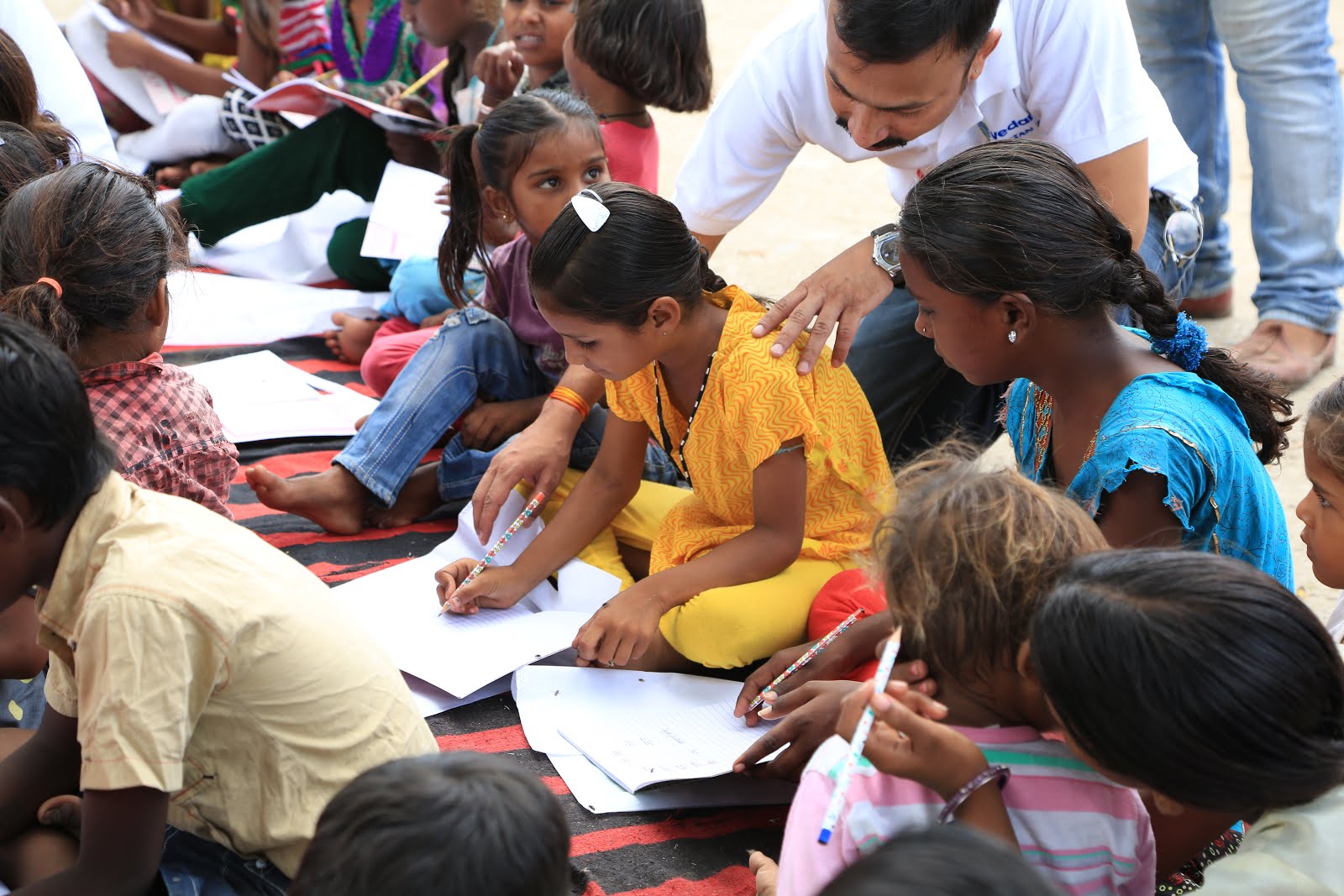
The 2-day painting workshop organized by KHUSHI team with about 150 slumchildren of 2-13 years of age was conducted to motivate them to join formal schools. 


VEDANTA KHUSHI - GLIMPSE OF KHUSHI WORKSHOP AT BEDAWAS

Almost 150 children who participated in a workshop organized by Hindustan Zinc under the Project “Khushi” came up with demand for school in their locality. The parents of these children also requested for a school that can educate these children who are keen to study.

VEDANTA KHUSHI - KHUSHI TEAM ORGANIZED A WORKSHOP WITH 150 SLUM CHILDREN

Vedanta Khushi  believes in making combine efforts to bring the change.
KHUSHI team was organized the workshop and about 150 children, in the age-group of 3 to 15 years with almost 70% girls, participated in the workshop which had lessons on literacy, creative skills, moral teachings and nutrition values.

VEDANTA KHUSHI - INAUGURATION OF KHUSHI CENTRES AT RAJSAMAND

Honourable Minister for WCD madam Smt. Anita Badhel Ji and Minister PHED Madam Smt. Kiran Maheshwari Ji launched the Khushi centres at Rajsamand on 11th July, 2016. About 600 Khushi centres became active.


VEDANTA KHUSHI - 150 SLUM CHILDREN OF BEDAVAS IN UDAIPUR DEMAND SCHOOL


When Komal, an 8 year old girl from Bedavas was asked why she is not going to school, she replied, how do I go school? I am scared of crematorium, a big well and highway. Why we don’t have school in Bedavas. 

Almost 150 children who participated in a workshop organized by Hindustan Zinc under the Project “Khushi” came up with demand for school in their locality. The parents of these children also requested for a school that can educate these children who are keen to study.


The children in the rural areas face the problem of commutation to the schools. Either the schools are not available in the colony or the children need to travel to school in tough conditions.


With the purpose of inculcating education in poor children, particularly in slum areas, Hindustan Zinc project “Khushi” organized a 2-day workshop on 1st and 2nd July 2016 in Bedavas which falls within the city of Udaipur. About 150 children, in the age-group of 3 to 15 years with almost 70% girls, participated in the workshop which had lessons on literacy, creative skills, moral teachings and nutrition values.

Bedavas has hygiene problem though almost every house has a toilet. As the children came to know that something new is about to happen, almost from every house they came running. A brief was given by Pavan Kaushik, who is the Founder of Project “Khushi” to all the children and their parents about the workshop and how every child has to come to attend the workshop only after taking bath, brushing teeth and properly combed. For this each child was given a tooth brush, a paste, a comb and soap on 1st July itself.

On 2nd July almost all the children came properly dressed and after adhering to the instructions given by “Khushi”. The parents of these children also sat, taking a little distance. 

The workshop began with lessons on literacy. Each child was asked to write their name and few moral values as they were given a note-book, a pencil, a sharper and eraser. Some knew how to write and some were taught. Post class on literacy, the children were given colour books and colours. Each child had to be accurate in colouring the pictures that showed the pattern of colour.


“It is our experience that children in slums and on streets need proper guidance and motivation to educate themselves. When you motivate them to go to school they need schools. The motivation and the infrastructure need to meet or else such workshops may not have long-term impact. In case of Bedavas, all they need is a small school with a teacher and a sustainable infrastructure”, 

- Pavan Kaushik.


The members of the “Khushi” project – Pradhuman Solanki, Maitreyee Sankhla, Devika Gupta, Ankita Das, Mukesh Mundra, Shiv Narayan, Sunil Gothwal and Diksha, advised almost each child on colouring and found that few had an amazing hand on creativity.

In the end, as part of providing nutrition to the children, each child was given a mango and 2 bananas which the child had to eat at the location itself. 


.


VEDANTA KHUSHI - 150 SLUM CHILDREN OF BEDAVAS IN UDAIPUR DEMAND SCHOOL


When Komal, an 8 year old girl from Bedavas was asked why she is not going to school, she replied, how do I go school? I am scared of crematorium, a big well and highway. Why we don’t have school in Bedavas. 

Almost 150 children who participated in a workshop organized by Hindustan Zinc under the Project “Khushi” came up with demand for school in their locality. The parents of these children also requested for a school that can educate these children who are keen to study.


The children in the rural areas face the problem of commutation to the schools. Either the schools are not available in the colony or the children need to travel to school in tough conditions.


With the purpose of inculcating education in poor children, particularly in slum areas, Hindustan Zinc project “Khushi” organized a 2-day workshop on 1st and 2nd July 2016 in Bedavas which falls within the city of Udaipur. About 150 children, in the age-group of 3 to 15 years with almost 70% girls, participated in the workshop which had lessons on literacy, creative skills, moral teachings and nutrition values.

Bedavas has hygiene problem though almost every house has a toilet. As the children came to know that something new is about to happen, almost from every house they came running. A brief was given by Pavan Kaushik, who is the Founder of Project “Khushi” to all the children and their parents about the workshop and how every child has to come to attend the workshop only after taking bath, brushing teeth and properly combed. For this each child was given a tooth brush, a paste, a comb and soap on 1st July itself.

On 2nd July almost all the children came properly dressed and after adhering to the instructions given by “Khushi”. The parents of these children also sat, taking a little distance. 

The workshop began with lessons on literacy. Each child was asked to write their name and few moral values as they were given a note-book, a pencil, a sharper and eraser. Some knew how to write and some were taught. Post class on literacy, the children were given colour books and colours. Each child had to be accurate in colouring the pictures that showed the pattern of colour.


“It is our experience that children in slums and on streets need proper guidance and motivation to educate themselves. When you motivate them to go to school they need schools. The motivation and the infrastructure need to meet or else such workshops may not have long-term impact. In case of Bedavas, all they need is a small school with a teacher and a sustainable infrastructure”, said Pavan Kaushik.


The members of the “Khushi” project – Pradhuman Solanki, Maitreyee Sankhla, Devika Gupta, Ankita Das, Mukesh Mundra, Shiv Narayan, Sunil Gothwal and Diksha, advised almost each child on colouring and found that few had an amazing hand on creativity.


In the end, as part of providing nutrition to the children, each child was given a mango and 2 bananas which the child had to eat at the location itself. 
.


A KHUSHI DATE WITH CHILDREN OF BEDAVAS


Over 125 children of different age-groups gathered around us to horde the basic items we brought for them towards their hygiene. A set of toothbrush, toothpaste, comb and soap was all that took for them to ascend in huge numbers”, Devika Gupta a member of Khushi Group

If I ask you, ‘What is the most important thing to you?’ The answers would range from family, well-being, good health, contentment and happiness. The one thing which is not a mainstream priority in our check list but is something that is omnipresent, for which all of us are running is - happiness. How you interpret happiness and how others might can be completely different while the essence of it remains the same.
‘Khushi’, literally translated as happiness, is an initiative by Hindustan Zinc, a company of Vedanta Group, which is aiming to spread smiles in deprived and underprivileged children. Other than inciting beaming faces, it also realizes the importance of the age old saying – ‘health is wealth’. Building up on the three most important pillars for a child’s welfare, Khushi believes in ‘health’, ‘nutrition’ and ‘education’ to such children.
India is a home to a third of the world’s total malnourished children and also houses 18 million kids who work on the streets. In such an unfortunate scenario, with such enormous and harrowing statistics ogling at us, there remains little hope that gives us solace for a better condition of these kids who are a part of the country’s future. Though India might be a growing economy with progressively emerging riches in the society, it still has around a fifth of the population below the poverty line that can barely afford minimum means of subsidence. That being said, I do not mean to bring you down or make you feel guilty, but to draw your attention to those who do not and might never get a chance to enjoy the lap of luxury that we intend to.
Now in our daily lives with busy schedules, where we are working hard and saving up for the future and our children, we do feel for those who cannot afford it. Here is where project Khushi steps in. It is said that ‘charity begins at home’, thus Khushi decided to spread happiness in a slum called Bedavas in Udaipur, Rajasthan. Over 125 children of different age-groups gathered around us to horde the basic items we brought for them towards their hygiene. A set of toothbrush, toothpaste, comb and soap was all that took for them to ascend in huge numbers. These kids were overjoyed to see us and could not wait 2nd July which is when the nutrition and education aspect would be taken care of by distributing fruits and teaching the kids to write their name.
2nd July is now enthusiastically awaited.